
Other News from Participating Centers

Is the First Amendment Obsolete?

Essay by Tim Wu: “The First Amendment was a dead letter for much of American history. Unfortunately, there is reason to fear it is entering a new period of political irrelevance. We live in a golden age of efforts by governments and other actors to control speech, discredit and harass the press, and manipulate public debate. Yet as these efforts mount, and the expressive environment deteriorates, the First Amendment has been confined to a narrow and frequently irrelevant role.
New program wants to improve cities with the power of tweets and Flickr uploads

Marissa Clifford at Curbed: “Want to watch street life unfold outside of New York’s Metropolitan Museum of Art, long after it’s closed for the day? Or uncover the hidden ways both tourists and locals alike use Manhattan’s most famous landmarks? Now you can, all thanks to the power of data.

Co-creating an Open Government Data Driven Public Service: The Case of Chicago’s Food Inspection Forecasting Model

Conference paper by Keegan Mcbride et al: “Large amounts of Open Government Data (OGD) have become available and co-created public services have started to emerge, but there is only limited empirical material available on co-created OGD-driven

Share to Transform Cities for the Common Good

Why Shareable?

Prof. Dr. Christoph J. Börner neuer Prorektor für Studienqualität und Personalmanagement

Prof. Börner übernimmt die Schlüsselthemen Lehre sowie Sicherung der Studienqualität und kümmert sich um das Personalmanagement. Er gehört mit seinem Lehrstuhl für Betriebswirtschaftslehre, insb. Finanzdienstleistungen – ebenso wie sein Vorgänger – der Wirtschaftswissenschaftlichen Fakultät an. Damit bleibt auch in diesem Punkt die Kontinuität im Rektorat gewährleistet.

Ethical Guidelines for Applying Predictive Tools Within Human Services

MetroLab Network: “Predictive analytical tools are already being put to work within human service agencies to help make vital decisions about when and how to intervene in the lives of families and communities. The sector may not be entirely comfortable with this trend, but it should not be surprised.

Are countries with a poor democratic record more likely to mandate an Aadhaar-like ID?

 at the Centre for Communication Governance: “Can a country’s democratic record indicate whether it is likely to mandate a national biometric identity? Research by scholars at the National Law University, Delhi suggests there may be some correlation, at least to indicate that robust democracies have been more cautious about adopting biometric identity systems.

Blockchain for Science – Hack’n’Share Weekend

This Hack’n’Share Weekend aims at bringing the blockchain tech community together with scientists, create engagement and hope to win talent for the living knowledge network. There will be lightning talks, discussion rounds... MORE

Privacy, Personality, and Flows of Information 3rd Edition: Asian Perspectives for Privacy as a Global Human Right

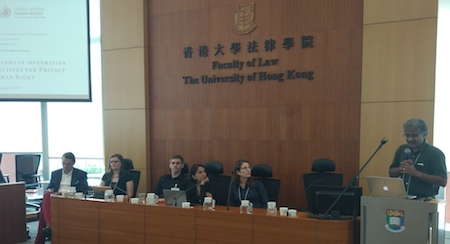
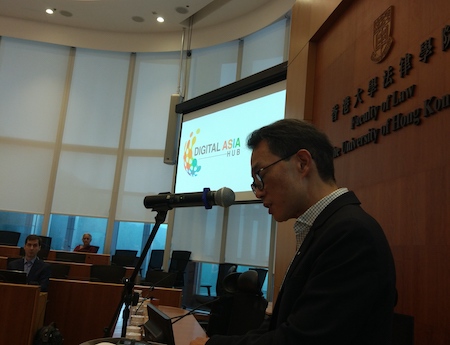
Digital Asia Hub, along with partners, the United Nations Special Rapporteur for Privacy, Mapping Project, University of Groningen, University of Malta, and University of Hong Kong (HKU), held a two-day conference “Privacy, Personality, and Flows of Information 3rd Edition: Asian Perspectives for Privacy” from September 29-30, at the Law School at HKU.


The Case for Local, Community-led Sustainable Energy Programs

Wolfgang Hoeschele: The energy infrastructure that we inherited from the 20th century is one dominated by fossil fuels and uranium, mined in relatively few localities in the world. The distribution and refining of these fuels is tightly held by a few large corporations. Electricity generation typically occurs in plants that hold local or regional monopolies, with vast profit potential.

On Social Media, How Can DHS Tell Who’s an Immigrant?

On September 18, the Department of Homeland Security (DHS) revealed a new policy for collecting immigrants’ social media information.
Location

United States

See map: Google Maps

Gamification, Participatory Democracy and Engaged Public(s)

Paper by Gianluca Sgueo: “The use of game-design elements – a phenomenon known as ‘gamification’ – features prominently within on-going processes of innovation of governance. According to the research and advisory firm Gartner, 2,000 of the top public organizations worldwide have at least one gamified application and/or process in place.

Digitaler Salon: iCare for you

Plush robots, smart walking aids and digital conversation partners: Could machines possibly relieve the nursing sector and simulate feelings? And should they do so? Next month we’re discussing robots in... MORE

Global Catastrophic Risks 2017

29 September 2017

Global Catastrophic Risks 2017 is an annual analysis of the greatest threats to humanity produced by the Global Challenges Foundation. It is based on the latest scientific research and features contributions from leading experts at think tanks, university departments and other institutions worldwide. As well as exploring the risks themselves, it summarizes the current status of global efforts to manage them.

Michael Latzer as Visiting Professor at Université Paris II Panthéon-Assas

Michael Latzer as Visiting Professor at Université Paris II Panthéon-Assas

Powrót do szkoły – powrót do reformy prawa autorskiego dla edukacji

Wakacje już na dobre zakończyły się w Brukseli, oznacza to, że nadszedł najwyższy czas na wznowienie prac nad europejską reformą prawa autorskiego. Najważniejsza w tej kwestii Komisja Prawna JURI podejmie decyzję dotyczącą kierunku reformy najprawdopodobniej w listopadzie tego roku.

Exzellenzstrategie: HHU mit CEPLAS II im Finale

DFG und WR haben heute bekannt gegeben, welche Universitäten oder Forschungsverbünde ihre Vollanträge für Exzellenzcluster einreichen dürfen. Die HHU wird sich demnach um die weitere Förderung des Exzellenzclusters für Pflanzenwissenschaften – SMARTe Pflanzen für die Anforderungen von morgen (CEPLAS II) bewerben.

Pollinating Prosperity: Michael Shuman on how to incubate generative economies

Most local administrations are promoting start-up incubators whose very models of business development often create a huge leakage for the local economy. Michael Shuman calls for local incubators who have a generative effect on the local economy, which he explains very cogently in this video:
‘Pollinating Prosperity’, presentation by local economic development expert Michael Shuman in Adelaide, South Australia, March 2016:

Launch Party for Shareable’s New Book and Crowdfunding Campaign

Chris Rankin: On Wednesday, Sept. 13, we celebrated the launch of our new book, “Sharing Cities: Activating the Urban Commons” and crowdfunding campaign, at the Embassy Network house in San Francisco, California. We are grateful to everyone who joined us for a fun and inspiring evening.

2. Oktober 2017: Parkplatz P2 gesperrt

Am 2. Oktober 2017 findet die jährliche allgemeine Einführung durch alle Fachschaften sowie den Vorstand des Allgemeinen Studierendenausschusses (AStA) der HHU für Studieneinsteigerinnen und -einsteiger statt. Hierfür wird Parkplatz P2 als Veranstaltungsfläche für den allgemeinen Verkehr gesperrt; Nutzer müssen auf andere Parkplätze am Campus ausweichen oder alternative Verkehrsmittel wählen. Halter dort geparkter Fahrzeuge sind gebeten, diese zu entfernen, da sie sonst kostenpflichtig abgeschleppt werden.
Für die Anreise zur HHU mit öffentlichen Verkehrsmitteln bieten sich an: