
Other News from Participating Centers

U. de Chile y Academia China de Ciencias Sociales suscribieron acuerdo

La ceremonia, desarrollada en el marco de la visita a Chile del Presidente chino Xi Jinping, fue encabezada por las máximas autoridades de ambas instituciones, el profesor Wang Weiguang y el Rector Ennio Vivaldi, y representantes del Ministerio de Relaciones Exteriores.3.300 investigadores, 180 centros de estudio, 38 institutos de investigación y 5 editoriales son algunas de las cifras que dan cuenta de la relevancia de la Academia China de Ciencias Sociales (CASS, por su sigla en inglés), institución con la que la Universidad de Chile firmó este ma
U. de Chile reafirmó su compromiso con el país en su 174º Aniversario

Con diferentes actividades que involucraron al conjunto de la comunidad, la Universidad de Chile celebró sus 174 años de existencia como la principal institución de educación pública del país.

Direito Rio e CVM lançam cartilha do investimento coletivo

Lançamento foi realizado no último dia 25 de novembroA Escola de Direito do Rio de Janeiro da Fundação Getulio Vargas (Direito Rio) e a Comissão de Valores Mobiliários (CVM) lançaram, no dia 25 de novembro, a Cartilha do Investimento Coletivo: orientações a investidores e gestores, seguido de um debate público sobre equity crowdfunding no Brasil.

Just good enough data: Figuring data citizenships through air pollution sensing and data stories

Jennifer Gabrys, Helen Pritchard, and Benjamin Barratt in Big Data & Society: “Citizen sensing, or the use of low-cost and accessible digital technologies to monitor environments, has contributed to new types of environmental data and data practices.

Maybe the Internet Isn’t a Fantastic Tool for Democracy After All

 in NewYork Magazine: “My favorite story about the internet is the one about the anonymous Japanese guy who liberated Czechoslovakia. In 1989, as open dissent was spreading across the country, dissidents were attempting to coordinate efforts outside the watchful eye of Czechoslovak state security.

Towards Scalable Governance: Sensemaking and Cooperation in the Age of Social Media

Iyad Rahwan in Philosophy & Technology: “Cybernetics, or self-governance of animal and machine, requires the ability to sense the world and to act on it in an appropriate manner. Likewise, self-governance of a human society requires groups of people to collectively sense and act on their environment.

From policing to news, how algorithms are changing our lives

Carl Miller at The National: “First, write out the numbers one to 100 in 10 rows. Cross out the one. Then circle the two, and cross out all of the multiples of two. Circle the three, and do likewise. Follow those instructions, and you’ve just completed the first three steps of an algorithm, and an incredibly ancient one.

The data-driven social worker

NESTA: “Newcastle City Council has been using data to change the way it delivers long-term social work to vulnerable children and families.
Social workers have data analysts working alongside them. This is helping them to identify common factors among types of cases, understand the root causes of social problems and create more effective (and earlier) interventions.
What is it?

Big Data Coming In Faster Than Biomedical Researchers Can Process It

Richard Harris at NPR: “Biomedical research is going big-time: Megaprojects that collect vast stores of data are proliferating rapidly. But scientists’ ability to make sense of all that information isn’t keeping up.
This conundrum took center stage at a meeting of patient advocates, called Partnering For Cures, in New York City on Nov. 15.

Making sense of government spending: Open Knowledge Finland use OpenSpending to collaborate with Finnish Government

Tampere, Finland (public domain)
This piece is written by Jaakko Korhonen and Joonas Pesonen of Open Knowledge Finland
At the end of October a team using OpenSpending tools held a pitch for high-ranking Finnish Government officials in “Hack the Budget 2016,” a competition organised by Open Knowledge Finland (OKFFI) and the Finnish Ministry of Finance.

How Should a Society Be?

An Edge Conversation With Brian Christian: “This is another example where AI—in this case, machine-learning methods—intersects with these ethical and civic questions in an ultimately promising and potentially productive way. As a society we have these values in maxim form, like equal opportunity, justice, fairness, and in many ways they’re deliberately vague.

CEIPI Opinion on a EU Proposal for a Neighboring Right for Press Publishers Online

At CEIPI, I have co-authored with Christophe Geiger and Oleksandr Bulayenko a position paper discussing the proposed introduction in EU law of neighboring rights for press publishers for the digital uses of their publications. The proposal is included in the European Commission’s Draft Directive on copyright in the Digital Single Market of September 14, 2016. Below you find the summary of the paper:
Location

United States

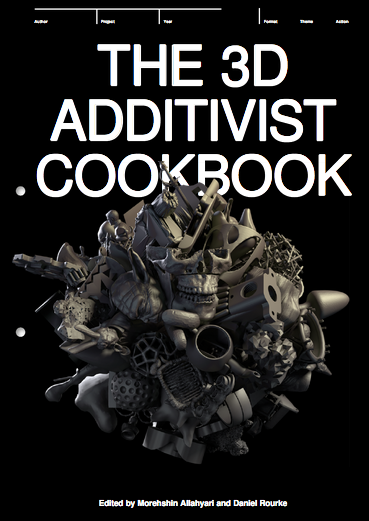
Out now: The 3D Additivist Cookbook

The 3D Additivist Cookbook, devised and edited by Morehshin Allahyari and Daniel Rourke, is a compendium of imaginative, provocative works from over 100 world-leading artists, activists and theorists. The 3D Additivist Cookbook contains 3D .obj and .stl files, critical texts, templates, recipes, (im)practical designs and methodologies for living in this most contradictory of times.

What Elaine Chao as Transportation secretary could mean for commercial drone use

Location

United States

See map: Google Maps

Instagram is the latest social media firm to tweak its app in an attempt to prevent harassment

Location

United States

See map: Google Maps

Making the Case for Evidence-Based Decision-Making

Jennifer Brooks in Stanford Social Innovation Review: “After 15 years of building linkages between evidence, policy, and practice in social programs for children and families, I have one thing to say about our efforts to promote evidence-based decision-making: We have failed to capture the hearts and minds of the majority of decision-makers in the United States.

OpenStreetMap in Israel and Palestine – ‘Game changer’ or reproducer of contested cartographies?

Christian Bittner in Political Geography: “In Israel and Palestine, map-making practices were always entangled with contradictive spatial identities and imbalanced power resources.

The 'Right to Be Forgotten' and Privatized Adjudication

December 8, 2016Guadalajara, Mexico

Memo to President Obama: You Have Another Memo to Withdraw

Location

United States

See map: Google Maps

Apple hints that self-driving car rumors may be true in recent letter to NHTSA

Location

United States

See map: Google Maps